Keplar
How to Build a Balanced College List: Reach, Target and Likely Schools
A practical guide to the college search: how to sort schools into reach, target and likely using admit rates and SAT ranges, how many to apply to, and a month-by-month timeline.

A good college list isn't the 15 most famous names you can think of. It's a set of schools you'd genuinely be glad to attend, spread across different levels of selectivity, so that next spring you're choosing between offers rather than hoping for one. Here's how to build it.
Start with what you want, not with rankings
Before you look at a single admit rate, write down what actually matters to you. Five questions do most of the work:
- What might you study? If you're unsure, favour schools that are strong across many fields and make it easy to switch majors.
- What size feels right? A 2,000-student college and a 40,000-student university are completely different experiences.
- Where? Distance from home, city or campus town, climate.
- What can your family pay? Have this conversation early. It changes the list more than anything else.
- What else is non-negotiable? A sport, a program, co-ops, religious life, a particular kind of community.
Use these to build a long list of 20–30 schools from search tools, the U.S. Department of Education's College Scorecard, friends' recommendations and your school counsellor. Then sort.
Sort every school: reach, target or likely
For each school, compare your academic profile (grades, course rigour and SAT score) with the school's typical students, and look at the admit rate:
| Category | Rule of thumb |
|---|---|
| Reach | Your SAT is below the school's middle-50% range, or the school admits fewer than about 15–20% of applicants, whatever your scores. |
| Target | Your SAT and grades are inside the middle-50% range and the admit rate is moderate. |
| Likely | Your SAT is at or above the 75th percentile and the school admits a large share of applicants (often more than half). |
The second half of the reach rule is the one students most often forget. When a college turns away more than four out of five applicants, most of them academically qualified, it's a reach for everyone. A 1580 doesn't change that.
Where do you find the numbers? Many colleges publish admit rates and score ranges on their admissions sites, and College Scorecard lists them for most U.S. colleges. Our roundup of SAT policies at 25 top colleges includes recent ranges for the most selective ones.
Get the balance right
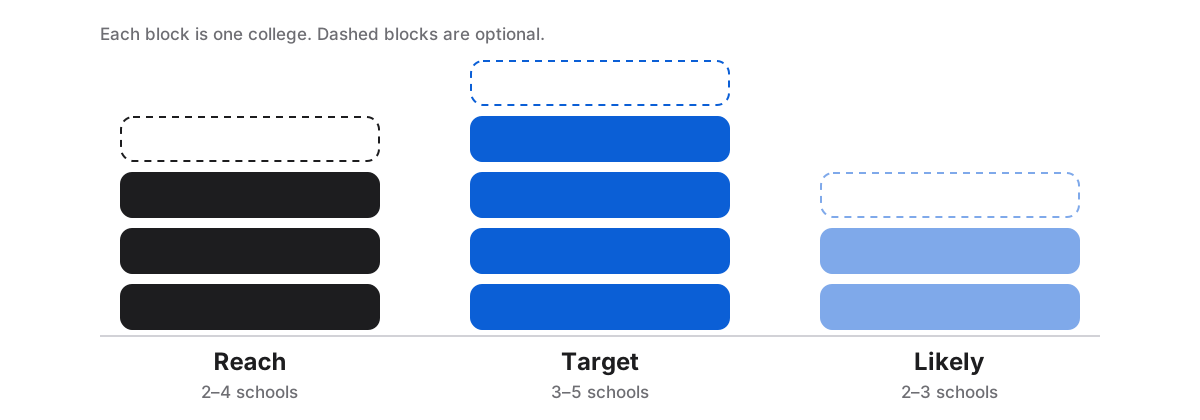
Many students end up applying to somewhere between 6 and 12 schools. Whatever the total, aim for roughly:
- 2–4 reaches you'd love to attend.
- 3–5 targets, the heart of the list, where you have a real chance.
- 2–3 likely schools you'd be genuinely happy at and could afford.
The test of a good list: if you were admitted only to your likely schools, would you be excited to go? If not, keep looking. There are hundreds of excellent colleges beyond the famous names.
Check the money early
Sticker price is misleading. Many colleges, especially wealthy private ones, meet a large share of financial need, which can make them cheaper than a public university for some families. Every U.S. college has a net price calculator on its website (the Department of Education keeps a directory of them). Run it for each school on your list with your family, and make sure at least one likely school is affordable even without any aid.
Where the SAT fits in
Your SAT score moves schools between categories. Fifty points can turn a reach into a target at some colleges. That's why it helps to know your score before your list is final:
- Take a diagnostic practice test early to see roughly where you stand.
- Check each college's testing policy. Some require scores, some are optional and some ignore them entirely.
- If a few points would move several schools into your target range, that's a strong case for one more focused round of prep. A study schedule helps you fit it in.
A month-by-month timeline
| When | What to do |
|---|---|
| Junior year, fall | Take the PSAT if your school offers it. Start a long list. Visit any campuses near you. |
| Junior year, winter | Diagnostic SAT practice test; start a study plan. Talk money with your family. |
| Junior year, spring | Take the SAT (spring dates include March, May and June). Narrow to 15–20 schools. Visit if you can. |
| Summer before senior year | Finalise a balanced list of 6–12. Draft your personal essay. Run net price calculators. |
| Senior year, fall | Retake the SAT if needed (fall dates include October, November and December). Early applications are often due November 1 or 15. |
| Senior year, winter | Regular decision deadlines, often early January. Send scores and financial aid forms. |
Deadlines vary by college and round. Put every school's exact dates, from its official admissions site, in one calendar, and add a reminder a few weeks before each.
Keep it organised
A college list turns into a lot of moving parts: deadlines for each round, testing policies, essays, recommendations and financial aid forms. A simple spreadsheet with one row per school, and columns for category, round, deadline, testing policy, essay status and net price, keeps it manageable. Update it every couple of weeks, and the last month before deadlines will be much calmer.
Common questions
How many colleges should I apply to?
There's no magic number, but many students apply to somewhere between 6 and 12. What matters more is balance: a few reaches, a solid middle of targets, and at least two likely schools you'd genuinely be happy to attend.
Is a college with a high SAT range always a reach?
If a college admits fewer than about 15–20% of applicants, treat it as a reach for everyone, whatever your scores, because so many qualified applicants are turned away. Below that level of selectivity, comparing your SAT and grades to the college's ranges is a good guide.
What's the difference between a safety school and a likely school?
They mean the same thing: a school where your academic profile is comfortably above the typical admitted student and the admit rate is high. 'Likely' is a more honest name, because no admission is guaranteed.
Should I include colleges I can't afford?
Don't rule colleges out on sticker price alone. Many offer significant need-based aid. Run each college's net price calculator early, and make sure at least one likely school is affordable without aid.
Sources
- U.S. Department of Education: College Scorecard
- Federal Student Aid: Net price calculator center
- College Board: SAT test dates and deadlines
Dates, policies and test details change. Check the official source before you make a decision.