Keplar
The Digital SAT, Explained: Sections, Timing, Adaptive Modules and Scoring
How the digital SAT works in 2026: two sections, four adaptive modules, 2 hours 14 minutes, the built-in calculator, how scoring works and the 2026–27 test dates.

The SAT moved fully online a couple of years ago, and the change was bigger than swapping paper for a screen. The test is shorter, the passages are shorter, every Math question allows a calculator, and the test adapts to how you're doing. If your mental picture of the SAT comes from an older sibling's prep book, here's what it actually looks like now.
The digital SAT at a glance
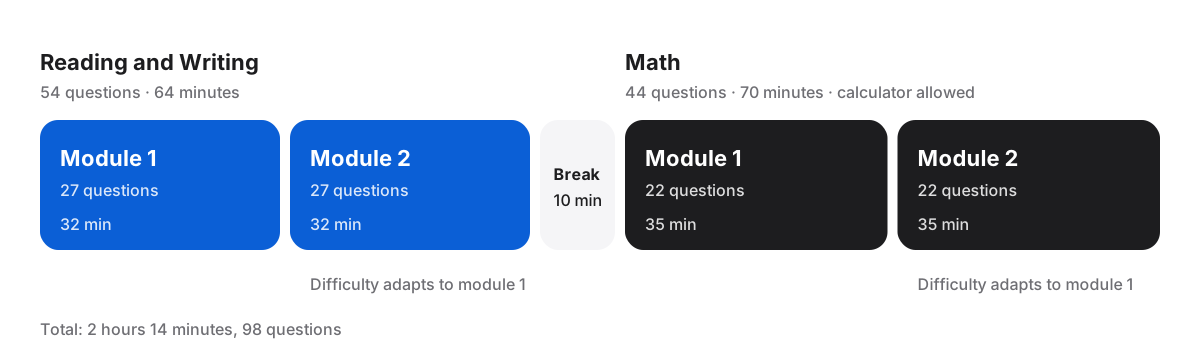
The SAT has two sections, Reading and Writing first and Math second. Each section is split into two timed modules, and there's a 10-minute break between the sections.
| Section | Modules | Questions | Time |
|---|---|---|---|
| Reading and Writing | 2 × 32 minutes | 54 | 64 minutes |
| Break | — | — | 10 minutes |
| Math | 2 × 35 minutes | 44 | 70 minutes |
| Total | 4 modules | 98 | 2 hours 14 minutes of testing |
You'll take the test in College Board's Bluebook app, on your own laptop or tablet or one borrowed from your school or College Board. Scratch paper is provided, and you can mark questions to come back to within a module.
How the adaptive modules work
The SAT is multistage adaptive. It doesn't change after every question the way some computer tests do; it adapts once per section:
- Module 1 is the same mix of easy, medium and hard questions for everyone.
- When the time is up, your performance on Module 1 decides which version of Module 2 you get: one that's harder on average, or one that's easier on average.
- Inside a module you can move back and forth, change answers and use the "mark for review" flag. Once the module ends, you can't go back to it.
Two practical consequences. First, Module 1 deserves your full focus: careless slips there can route you into the easier second module, which caps how high your score can go. Second, a second module that feels hard is usually good news. It often means you did well on the first.
What's in Reading and Writing
Forget long reading passages with ten questions each. Every Reading and Writing question has its own short passage (often a single paragraph, sometimes a poem excerpt or a pair of short texts, sometimes a table or graph) and exactly one question. The questions fall into four content areas:
- Craft and Structure: words in context, a text's structure and purpose, and connecting two texts.
- Information and Ideas: central ideas, details, inferences, and using evidence (including data from charts).
- Standard English Conventions: grammar, usage and punctuation, such as boundaries between sentences and subject–verb agreement.
- Expression of Ideas: transitions and "rhetorical synthesis" (choosing the option that uses notes to achieve a stated goal).
Because each passage is short, reading speed matters less than reading precision. Most wrong answers come from misreading what the question asks, not from running out of time.
What's in Math
Math covers four content areas: Algebra, Advanced Math (nonlinear functions and equations), Problem-Solving and Data Analysis (ratios, percentages, statistics, probability) and Geometry and Trigonometry. Most questions are multiple choice; some ask you to type in your own answer, where fractions and decimals are both accepted.
A few things are different from older versions of the test:
- A calculator is allowed on every question. Bluebook has a Desmos graphing calculator built in, and you can also bring an approved calculator.
- A reference sheet of common formulas is available in the app.
- Word problems are generally shorter and more direct than they used to be.
The built-in Desmos calculator is a genuine advantage if you've practised with it. Many algebra questions can be checked, or solved outright, by graphing both sides of an equation and reading off the intersection. It's worth getting fluent with it on desmos.com before test day.
How scoring works
- Each section is scored from 200 to 800, for a total of 400 to 1600.
- There's no penalty for wrong answers, so never leave a question blank.
- Scoring uses a statistical model that accounts for how difficult each question is, so it isn't a simple count of right answers. Reaching the harder second module is what makes the top of the range available.
- Scores typically post a couple of weeks after the test. Plan for two to four weeks, then a further week or two for colleges to receive them if you send scores later.
Two score-sending terms are worth knowing. Score Choice lets you choose which test dates to send, unless a college asks for all of them. Superscoring, which some colleges do, means combining your best section scores from different dates. Policies differ, so check each college's admissions site.
2026–27 test dates
These are the remaining weekend dates College Board lists for the 2026–27 school year (check the official dates page before registering, as deadlines are firm):
| Test date | Registration deadline | Late registration and changes |
|---|---|---|
| November 7, 2026 | October 23, 2026 | October 27, 2026 |
| December 5, 2026 | November 20, 2026 | November 24, 2026 |
| March 6, 2027 | February 19, 2027 | February 23, 2027 |
| May 1, 2027 | April 16, 2027 | April 20, 2027 |
| June 5, 2027 | May 21, 2027 | May 25, 2027 |
Many schools also run the SAT on a school day, in fall and spring windows. If your school offers it, you're registered through the school rather than on your own.
What this means for how you prepare
- Practise in Bluebook. The interface, the timer, the calculator and the review screen are part of the test. Take at least one full-length practice test in the app well before test day.
- Train precision over speed. Short passages reward careful reading of the question stem, and the adaptive design punishes early careless errors.
- Learn Desmos. Ten minutes a day graphing practice problems pays off across the whole Math section.
- Start with a baseline. A full practice test tells you which of the eight content areas are costing you the most points. Our guide to taking an SAT diagnostic test walks through how to turn that into a plan.
Common questions
How long is the digital SAT?
2 hours 14 minutes of testing time: 64 minutes of Reading and Writing and 70 minutes of Math, plus a 10-minute break between the two sections.
Can I use a calculator on the whole Math section?
Yes. A Desmos graphing calculator is built into the Bluebook testing app for every Math question, and you can bring an approved calculator of your own.
Does the first module matter more than the second?
It matters in a different way. Your performance on the first module of each section decides whether you get an easier or harder second module, and the harder second module is what opens up the top of the score range.
Is there a penalty for wrong answers?
No. Your score is based on the questions you answer correctly, so you should answer every question, even if you have to guess.
Sources
- College Board: Overview of the SAT structure
- College Board: SAT test dates and deadlines
- College Board: Bluebook and practice tests
Dates, policies and test details change. Check the official source before you make a decision.